A duplex quote is a number on a page. A duplex budget is a timeline of when money leaves your account. Most small builders and investors who come unstuck didn’t misjudge the total by much. They misjudged the timing, and ran short at lock-up or fixing with the next draw still weeks away.
Here’s what a duplex really costs in 2026, where the money goes stage by stage, and what to do when a stage doesn’t line up with your funding.
Key takeaways
- National ranges are wide. Current guides run from about $550k to $1.5m for two dwellings, before land.
- Quotes exclude a lot. Demolition, asbestos, site works, connections, council costs and holding costs usually sit outside the contract price.
- Plan for 10% contingency at the very least, more on a knockdown or a sloping block.
- The squeeze comes at stage changes, not at the total.
- Equity in property you already own can bridge a gap while the build loan or the sale catches up.
How much does it cost to build a duplex in 2026?
Different cost guides give different answers because they measure different things. Airtasker’s Oneflare cost guide puts a duplex at around $550,000 to $1.3 million excluding land, and other 2026 builder guides run higher, up to about $1.5 million, with per square metre rates anywhere from roughly $2,000 to $4,500 depending on city and finish. Treat all of them as indicative. They come from commercial sites, not a regulator.
For a reality check on the cost of one dwelling, the ABS reports the average new house approval was $517,430 in 2025-26, up 5.0 percent on the year before. That is the approved building value of a house, excluding land. A duplex is two dwellings on one block, with some shared costs, so don’t expect to halve a house price. Expect the second dwelling to be cheaper than the first, but not by much.
What moves your number most:
- City and trade availability. Sydney and Melbourne sit at the top of most ranges.
- Size and finish. Two 150 m² homes with stone benchtops are a different job to two 110 m² starters.
- The block. Fall, rock, reactive clay, trees and tight access add real money.
- Storeys. Double storey costs more per dwelling, but the slab and roof are smaller.
What sits outside the builder’s quote?
This is where budgets blow out. Read the exclusions page of any quote and expect to find some of these:
| Cost | Where it hits | Note |
|---|---|---|
| Land (if you’re buying) | Before anything | Stamp duty, legals, holding costs |
| Design, survey, soil test | Before approval | Plans often 3% to 5% of build cost, per Airtasker’s house build guide |
| Council and certifier fees | Approval | Vary a lot by council |
| Developer or infrastructure contributions | Approval or before construction certificate | Set by state and council |
| Demolition and asbestos | Start | Old fibro or sheeted houses can need licensed removal |
| Site works | Start | One NSW provider lists $30k to $150k depending on the block |
| Utility connections and meters | Slab to fixing | Two of everything |
| Landscaping, fencing, driveways | Before PC | Often a provisional sum |
| Subdivision of title | After PC | Strata or Torrens, plus surveyor and registration |
| Interest, rent, holding costs | Whole build | Often forgotten completely |
Don’t take the dollar ranges in other people’s tables as gospel. Get actual quotes for demolition, site works and connections before you lock in a budget. Those three are where most knockdown jobs surprise people.
When does the money leave the account? A stage table
Here’s the part the cost guides skip. Below is an example of how a duplex budget flows. The percentages are round figures for illustration, not a quote, and your contract will set its own stages.
Example: a small builder in Melbourne’s outer east is knocking down a house on a 700 m² block and building two three bedroom townhouses to sell. Round number total build contract: $1,000,000. Extras outside the contract: about $150,000.
| Stage | What happens | Example cash out | Typical pressure point |
|---|---|---|---|
| Pre-start | Demolition, plans, permits, contributions | $100,000 or more, paid before the first draw | You fund this from cash or equity |
| Base / slab | Earthworks, footings, slab | About 15% of contract | Services and site cut cost more than allowed |
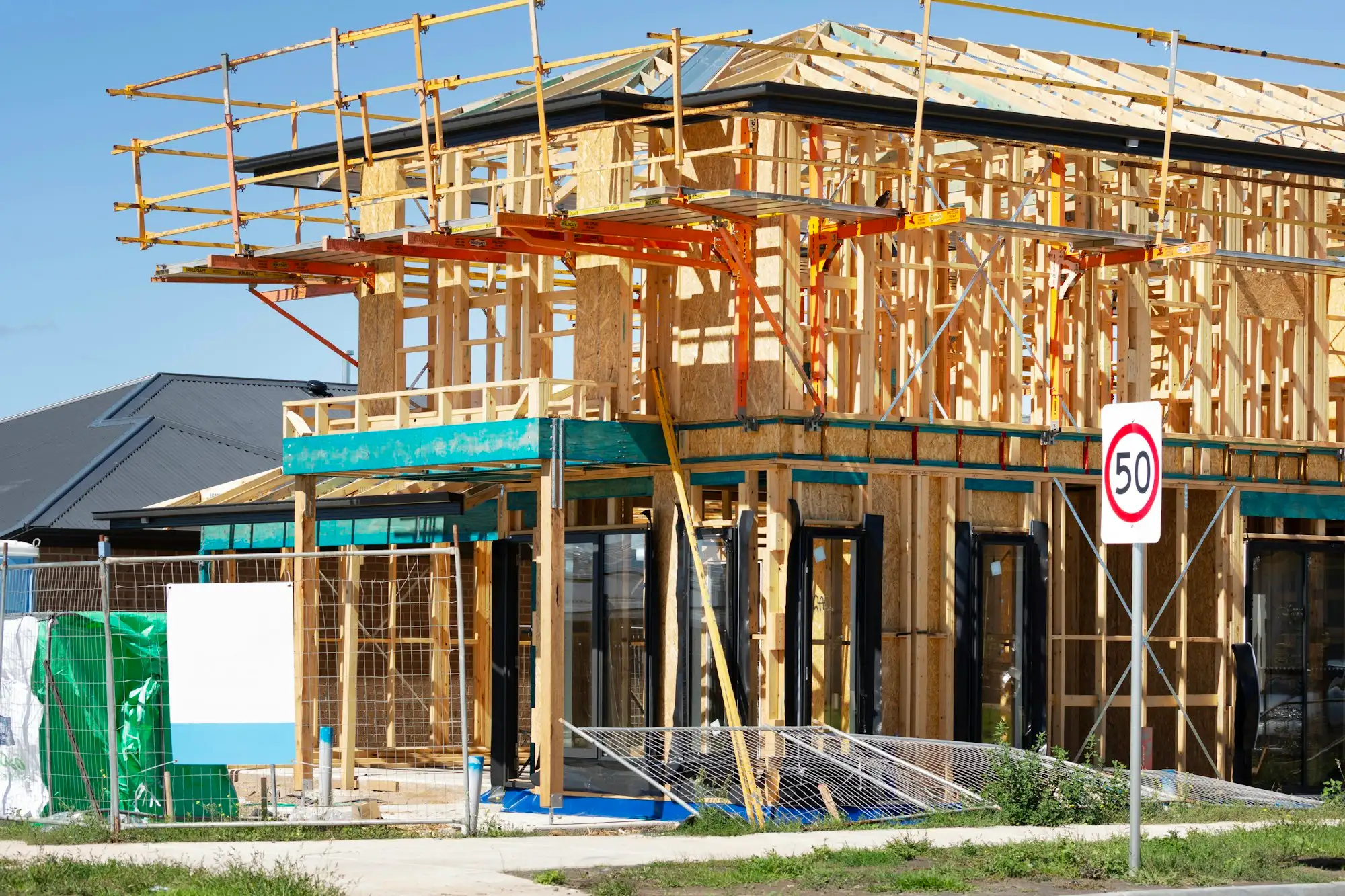
| Frame | Frame, trusses, roof frame | About 20% | Timber lead times and wet weather |
| Lock-up | Roof, windows, external cladding | About 25% | The big draw, and often the biggest supplier bills |
| Fixing | Plaster, cabinets, tiles, fit-out | About 25% | Many trades at once, wages and materials due together |
| Practical completion | Final trades, landscaping, certificates | About 15% | Fencing, driveways and defects |
| Titles and sale | Subdivision, strata, marketing, settlement | Extra costs, then the sale | You carry interest until the titles issue |
Notice that three stages (pre-start, lock-up and fixing) carry most of the cash pressure. Draws are normally paid after the stage is complete and checked, so you often fund the stage first and are reimbursed after. That’s the gap. Our guide on progress payments and cash flow gaps covers the same timing from the subbie’s side.
What did the 2025 planning changes do to duplex approvals?
They made duplexes easier to approve in some places. Check your council before you buy a block, because the rules differ street by street.
NSW. Dual occupancies and semi-detached homes became permitted on nearly all low-rise residentially zoned land from 1 July 2024. The Low and Mid-Rise Housing policy followed from 28 February 2025 and extended dual occupancies to land within 800 metres of 171 town centres and stations in Greater Sydney, the Central Coast, Illawarra-Shoalhaven and Hunter. Councils can still assess parking, light and frontage, and heritage conservation areas need council approval. Individual councils also set their own minimum lot sizes in some zones, so a “permitted” duplex may still fail on a 450 m² block.
Victoria. The new Townhouse and Low-Rise Code, introduced by Amendment VC267, came into operation on 31 March 2025. It changed how permit applications for two or more dwellings are assessed. Faster permits help a builder’s cash flow, because every month of waiting is a month of holding costs on land you’ve already paid for.
Neither change removes the cost of services, contributions or a difficult site.
How much contingency should you carry?
Start at 10 percent of the total budget, which is the figure Airtasker’s cost guide suggests for house builds. On a knockdown, push it towards 15 percent. Reasons a knockdown block bites:
- Asbestos in eaves, sheeting or under the slab
- Old stormwater or sewer lines that run where your new slab goes
- Tree roots, fill or reactive soil that change the footing design
- Variations, which aren’t always paid by the client if the paperwork isn’t right
Most lenders’ valuers and your own bank balance will both thank you for a contingency that is real money, not a line on a spreadsheet.
Where does the money come from?
Small builders usually stack several sources:
- Your own cash or the sale of another asset. Land deposit, demolition, plans and permits.
- A construction loan. Draws come against a fixed price contract and valuations at each stage. Owner builders often struggle to get one, and banks can be slow when the contract changes.
- Equity in property you already own. If you own a home, an investment property or land with equity, a short term loan secured against it can fund pre-start costs, bridge between draws or cover an overrun. Loans run from $20,000 to $5 million for business and investment purposes, terms typically 1 to 12 months, and funding can happen in as little as 24 hours once the valuation and documents are in. Our loans are secured against property you or a guarantor already own, never against the finished duplex.
- An unsecured cash flow loan. If you don’t have property to use, and you’ve traded 6 months or more with an ABN, a business cash flow loan sized to your turnover can cover materials or wages between draws.
Work out how much usable equity you have with the construction equity calculator before you commit to a land purchase or a contract. See what a duplex and townhouse construction loan looks like if you’re building to sell or hold.
Got a stage coming up that your account won’t cover? Check your options before the draw is late, not after.
What happens if a stage runs late or over?
A late stage costs you twice. Interest and holding costs keep running, and the next draw doesn’t release until the stage is signed off. A few habits help:
- Know your next draw date, not just the total. Count back from the supplier due dates to find the real low point in your account.
- Keep the exit simple. A short term loan works when it’s clear how it gets repaid: sale of one or both dwellings, or a refinance to a long term loan after practical completion. See our guide on exit strategies for short term loans.
- Talk early. If the bank has stopped, a stalled build can still be finished with the right funding, but it’s harder the longer it sits.
- Don’t pay the next supplier with the wages money. Fix the gap with funding, not by robbing another bill.
Ready to see where you stand?
Every duplex is a string of stages, and each stage needs money on the right day. If you’ve costed the job and found a gap, whether it’s the demolition bill, the lock-up draw or the wait for titles, it’s worth knowing your options before you sign the contract.
Enquiring takes about 60 seconds, and there’s no credit check when you first enquire, so asking won’t touch your credit file. Your details go to one lending specialist, not a pile of lenders, so your phone won’t light up with calls from people you’ve never heard of. A real person who understands building will look at your situation and call you back.
One favour: fill the form in accurately. Tell us what the money is for, the value of the property you own and what’s owed on it. That’s how we line up the right option first time.